

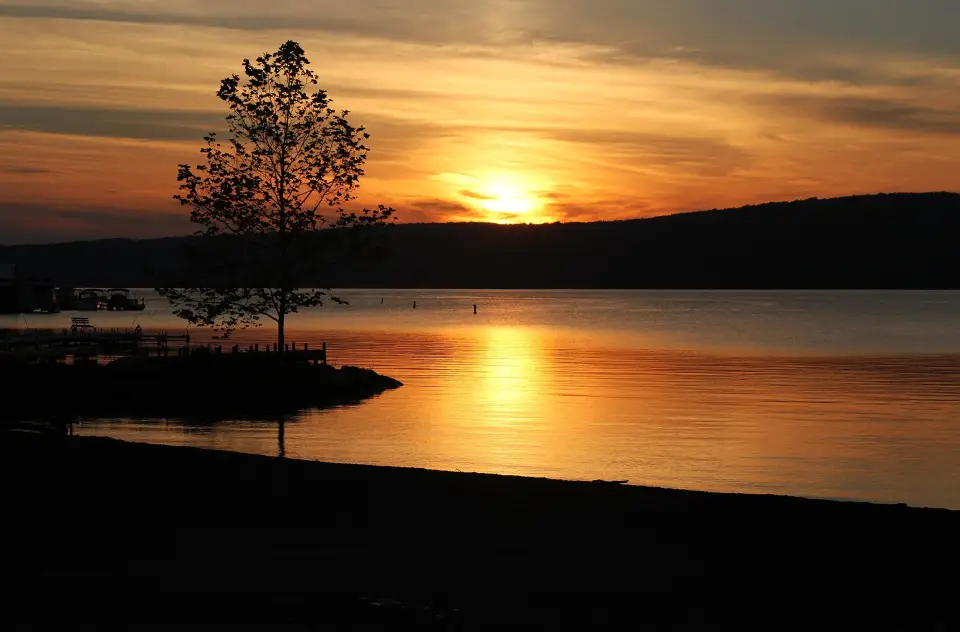
The Finger Lakes are eleven long, narrow, roughly north–south lakes in central and western New York, carved from river valleys by glaciers. Six are counted as the major lakes and five as the minor lakes.
Major and minor lakes
Seneca, Cayuga, Skaneateles, Owasco, Keuka and Canandaigua are considered the major Finger Lakes. Conesus, Hemlock, Canadice, Honeoye and Otisco are considered the minor ones. All eleven drain to Lake Ontario.
| Lake | Length | Max depth | Known for |
|---|---|---|---|
| Seneca | 38 mi | 618 ft | Largest and deepest; holds about half the water in the chain; Geneva and Watkins Glen |
| Cayuga | just under 39 mi | about 435 ft | Longest; Ithaca at the south end, Seneca Falls at the north |
| Keuka | 20 mi | 187 ft | Y-shaped “Crooked Lake”; Penn Yan, Hammondsport, early aviation |
| Canandaigua | 15.5 mi | — | Westernmost major lake; Canandaigua and Naples; mostly private shoreline |
| Skaneateles | 16 mi | 315 ft | Highest elevation; Syracuse drinks it unfiltered |
| Owasco | 11.1 mi | 177 ft | Auburn at the north end draws its drinking water from it |
| Conesus | 8 mi | 66 ft | Westernmost; the July 3 “Ring of Fire” flare tradition |
| Hemlock | 7 mi | 91 ft | Rochester water supply; shoreline virtually undeveloped; small boats only |
| Canadice | 3 mi | 95 ft | Smallest; no houses on the shore; Hemlock-Canadice State Forest |
| Honeoye | — | shallow | Second smallest, warmer and shallower than the rest |
| Otisco | — | — | Easternmost; dammed in 1869 to feed the Erie Canal |
A dash means we haven’t yet confirmed the figure from a source we trust; see the lake’s linked page.
How the lakes formed
The lakes began as northward-flowing river valleys. Over roughly two million years, repeated advances of the Laurentide Ice Sheet widened and deepened those valleys, and glacial debris dammed them. The lakes became ice-free roughly 14,400 years ago. Because the ice cut the main valleys so deeply, side streams were left “hanging” high above the lakes, and those hanging valleys are where the region’s famous gorges and waterfalls come from. See Waterfalls and gorges.
Whose land this is
The Finger Lakes are a central part of the Haudenosaunee (Iroquois) homeland. Seneca and Cayuga Lakes are named for the Seneca and Cayuga nations. Learn more on our history page, and at Ganondagan in Victor.
Lake water and algae
Since 2017 every Finger Lake has had at least one harmful algal bloom, and for most lakes it is now a yearly event. Check your lake association’s or the state’s bloom notices before swimming in late summer.
Living on the lakes year-round
The lakes share a climate and a state rulebook, but the details that matter most to owners (septic inspections, dock rules, drinking water) are set lake by lake and town by town. Our Finger Lakes living guides cover the region-wide rules, and our sister sites go deep on individual lakes: Living on Keuka, Living on Seneca and Living on Canandaigua.
How the lakes compare on septic rules
- Keuka: one uniform law in all eight lake municipalities, enforced by the Keuka Watershed Improvement Cooperative.
- Canandaigua: a state watershed regulation, a watershed inspection program, and town laws based on a shared model law.
- Seneca: no lake-wide law; county programs in Seneca and Schuyler Counties and town laws elsewhere.
The septic rules guide explains how the state and local rules fit together.
Sources and official links
- Wikipedia: Finger Lakes
- Wikipedia: Seneca Lake (New York)
- Wikipedia: Cayuga Lake
- Wikipedia: Keuka Lake
- Wikipedia: Canandaigua Lake
- Wikipedia: Skaneateles Lake
- Wikipedia: Owasco Lake
- Wikipedia: Conesus Lake
- Wikipedia: Hemlock Lake
- Wikipedia: Canadice Lake
- Wikipedia: Honeoye Lake
- Wikipedia: Otisco Lake
- NYS DEC: Harmful algal blooms
Hours, fees and seasonal openings change. Always check the official page before you go. Spot something out of date? Tell us at Partner with us.